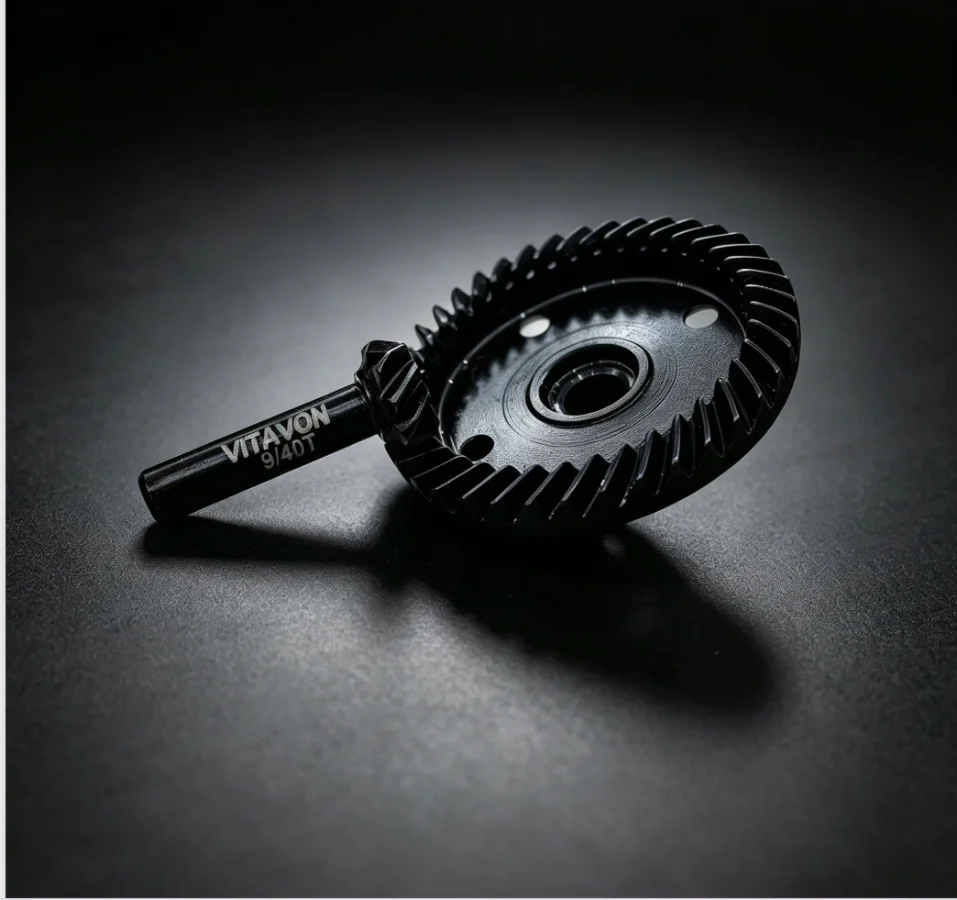
IMHO, if I owned a MT48 2.0, I'd stick with the stock gears. Before I state my hypothesis, let me first make a disclaimer that I am not an engineer by trade and have no insight into the manufacturing process for either Tekno or Vitavon.
That said, having built dozens of custom
high-end trucks that use parts from Tekno (obviously), M2C, Vitavon, Scorched Parts, and other manufacturers, I have noticed that Vitavon isn't ranked #1 based on their quality/ manufacturing tolerances.
That's not to say that Vitavon doesn't offer good products or that they have poor manufacturing tolerances, but rather, comparatively, competitors such as Scorched Parts and M2C Racing make higher-quality parts, both from a design and a manufacturing tolerances perspective.
From what I've come to know about manufacturing gears the process requires quite a bit of precision—and having dropped ~five figures worth of "bones" on Vitavon across multiple vehicles/ platforms/ product types, I haven't experienced that "wow" factor when it comes to precision.
When a company like Vitavon CNC-machines a ring gear out of raw steel, it might be perfectly flat and true. However, to make it durable enough, they must heat-treat (harden) the steel. Heating steel to extreme temperatures and quenching it inherently causes the metal to shrink, warp, and distort.
In full-scale automotive manufacturing, gears are CNC machined, heat-treated, and then put through a final process called
precision grinding, where a robotic grinding wheel shaves off the microscopic warps caused by the hardening process to restore perfect GD&T tolerances. Because precision post-hardening grinding is incredibly expensive, many RC aftermarket manufacturers skip it. You are left with a gear that is incredibly hard, but suffers from heat-warped axial runout (high spots on the gears).
While Tekno RC keeps their exact proprietary manufacturing steps closely guarded, their consistent lack of axial runout (high spots) comes down to a combination of
superior material selection, precise hobbing, and controlled heat treatment, rather than post-hardening precision grinding.
High-Grade Materials (Minimal Distortion)
The amount a gear warps during heat treatment depends heavily on the specific alloy of steel being used. Cheaper alloys expand and distort wildly when quenched. Tekno uses high-grade, aerospace-quality steel alloys specifically chosen for their dimensional stability. When these alloys are heat-treated, they experience minimal microscopic distortion, meaning they retain their CNC-machined flatness without needing an expensive post-grinding phase.
Advanced Gear Hobbing
Tekno RC doesn't just cut gears; they use advanced gear hobbing machines. Hobbing is a continuous cutting process that generates a near-perfect involute tooth profile. If a manufacturer uses a cheaper milling process or a worn hobbing tool, the teeth themselves will have slight variations in thickness or pitch. Tekno's tooling tolerances are exceptionally tight, meaning every tooth engages the pinion exactly the same way.
The "Lapped" Feel
While they likely do not precision-grind their standard gears (as that would make a $30 ring gear cost $150), high-end manufacturers sometimes use a process akin to
lapping. Lapping involves running the ring and pinion gears together with a mild abrasive compound before they leave the factory. This process wears down any microscopic high spots left over from heat treatment, ensuring the gear set is perfectly mated to itself.
Tekno's products are also made in Taiwan, whereas, Vitavon's parts are made in China. While products made in Taiwan are
typically more expensive to manufacturer, they are also
typically higher quality. This also
may explain why I have found that both Tekno and Traxxas hardened CNC gears are typically high quality with respect to tolerances.
That all said, if the OEM doesn't offer a high-quality, durable CNC hardened gear or driveshaft, I will buy the Vitavon upgrade all day long (i.e., I have the full set of hardened #45 steel gears and driveshafts on both my Losi Baja Rey 2.0 and Losi Lasernut).
Just my 2 cents... no idea if any of the assumptions I've made with regard to Tekno or Vitavon's manufacturing processes are true, or not, but I suppose a Tekno engineer can weigh in on that if they'd like to share some of the details relative to their process for manufacturing high-quality gears.
Again, I'm not an engineer. Just sharing my experience as a fellow hobbyist customer, like you, and also, speculation as to why Tekno's gears are higher quality than that of Vitavon's.
----
While I own every other Tekno platform/ model, I bought the "OG" MT410 and it's fully decked out with parts from M2C Racing, AllRacing, MMM (r.i.p), T-Bone Racing (r.i.p.), etc., and don't have the urge to buy the MT48 2.0. I can't say the same for just having "one" custom SCT48, as I just bought a "roller" from one of the SCT48 FB group members.